
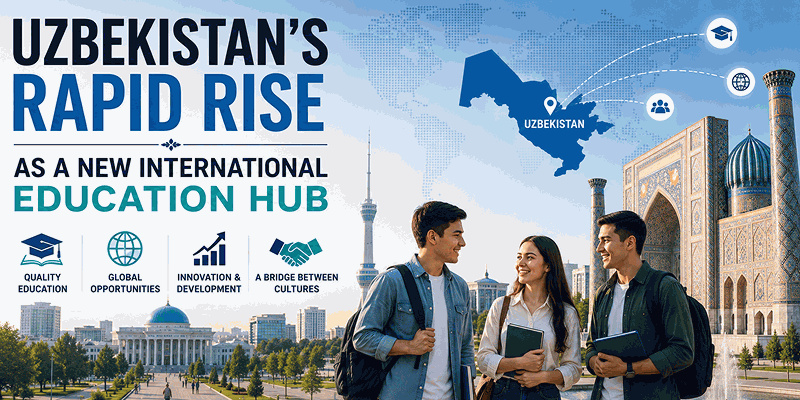
Uzbekistan’s Rapid Rise as a New International Education Hub
Uzbekistan is emerging as a promising new destination for international higher education. Recent figures according to Uzbekistan’s National Statistics Committee, show just how quickly this change is taking place. Between January and November 2025, around 37,200 international visitors came to the country for study related purposes. This marks an increase of more than 54% compared to the same period last year. Most of these students came from India, followed by Turkmenistan, Tajikistan, Pakistan, and China, highlighting Uzbekistan’s growing appeal across Asia and nearby regions.
Alongside short-term study visits, international student enrolment in Uzbek universities has also grown sharply. At the start of the 2024–2025 academic year, nearly 12,500 foreign students were enrolled in higher education institutions across the country. This number represents an almost eighteen-fold increase over the past decade, showing how rapidly Uzbekistan’s education sector is opening up to the world.
This progress is the result of careful planning rather than chance. Higher education has become a central part of Uzbekistan’s long-term national development vision, particularly under the Uzbekistan 2030 strategy. Universities are now seen as key drivers of modernisation, global engagement, and economic growth. As a result, institutions have invested in better facilities, introduced more English taught and career focused program, and strengthened partnerships with universities abroad.
For students from countries such as India and Pakistan, Uzbekistan offers a strong combination of recognised degrees, international exposure, and more affordable study costs compared to many traditional destinations. Medical education has seen strong growth, with a sharp rise in Indian students enrolling in Uzbek medical universities within a short period.
Kimyo International University in Tashkent (KIUT) is a good example of how Uzbek universities are adapting to this global shift. Founded in collaboration with South Korea’s Yeoju Institute of Technology, KIUT has expanded into a multi-campus university offering program in medicine, engineering, economics, and social sciences. It works with partner institutions across Europe, Southeast Asia, Central Asia, and North America, offers joint degree program, and hosts a diverse international faculty and student community. This approach reflects the wider direction of Uzbekistan’s higher education system toward global standards and stronger international cooperation.
For students looking beyond traditional study destinations, Uzbekistan now presents a compelling new option that combines academic quality with international connections. For universities and policy leaders, its progress demonstrates how targeted investment in higher education can strengthen a country’s position in the global knowledge economy and open doors to long term collaboration and mobility.
Related articles
More from Education news and recent posts.

International Master Students in Denmark- Evidence Challenges Political Doubts
International Master Students in Denmark- Evidence Challenges Political Doubts The case against international master’s students in Denmark is growing weaker…
Read article →
UK Universities Face Growing Financial Uncertainty as International Student Policies Shift
UK universities are entering one of the most financially difficult periods in decades, with a rising number of institutions reporting operating deficits as unc…
Read article →
Protecting Student Voices: US Court Victory Safeguards International Students’ Freedom of Speech
A Turning Point for International Students - US Court Victory Safeguards International Students’ Freedom of Speech In recent years, international students i…
Read article →