
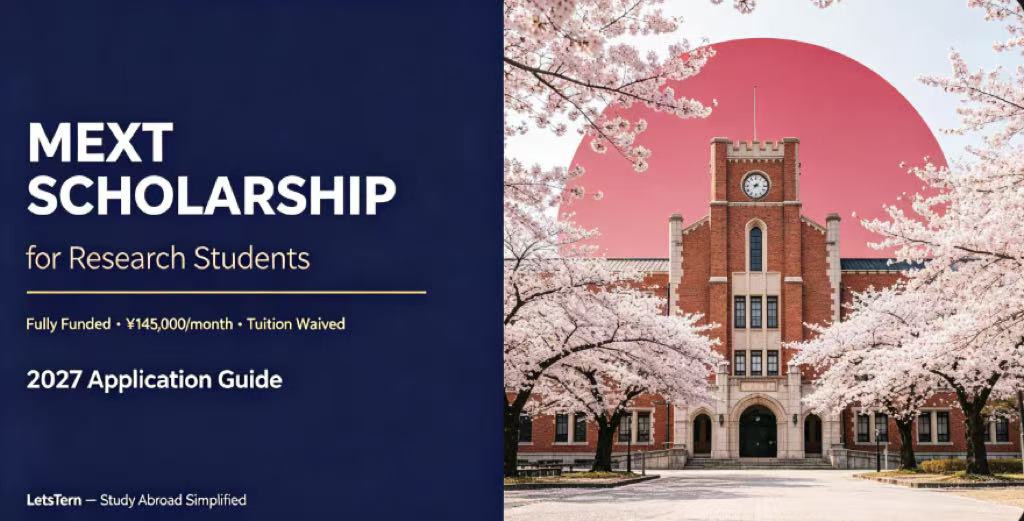
MEXT Scholarship for Research Students: Your Complete 2027 Guide
Japan's MEXT scholarship is one of the most generous government-funded awards in the world. It covers your tuition, pays your living expenses, and flies you there and back. But there's a catch: most applicants are rejected on their first try.
I've spent weeks digging through embassy websites, official guidelines, and firsthand accounts from actual MEXT recipients. What I found was a process that rewards preparation far more than raw intelligence.
If you're a graduate student or recent graduate who wants to conduct independent research at a Japanese university, this guide will walk you through exactly what the MEXT Research Student scholarship offers, who qualifies, and how to navigate the two-track application system that confuses almost everyone.
What Is the MEXT Research Student Scholarship?
The MEXT scholarship (Monbukagakusho) is administered by Japan's Ministry of Education, Culture, Sports, Science and Technology. It's been inviting international students to study in Japan since 1954 [citation:14]. The Research Student category is specifically designed for graduate-level researchers who want to pursue a master's degree or doctorate at a Japanese university [citation:8].
Unlike some scholarships that only cover tuition, MEXT is a true full-ride package. You get your tuition waived, a monthly living allowance, and economy-class round-trip airfare [citation:7].
What makes it different
Starting in 2024, MEXT Research Scholarship recipients are required to target a degree (master's or PhD). The old option of doing pure research without pursuing a degree is no longer available [citation:5].
What Does the MEXT Research Scholarship Cover?
The financial package is straightforward and substantial. Here's exactly what you receive:
| Benefit | Amount |
|---|---|
| Monthly stipend (non-regular students) | ¥143,000 |
| Monthly stipend (master's/professional students) | ¥144,000 |
| Monthly stipend (doctoral students) | ¥145,000 |
| Regional allowance (designated areas) | +¥2,000–3,000/month |
| Tuition, entrance exam, and graduation fees | Fully waived |
| Round-trip airfare | Provided |
The stipend amounts listed here reflect the 2025 Japanese fiscal year and are subject to change [citation:9].
Who Is Eligible to Apply?
The eligibility criteria are strict but not impossible to meet. Here are the core requirements:
- Age: You must be under 35 years old. For 2027 enrollment, that generally means born on or after April 2, 1992 [citation:11].
- Nationality: You must be a citizen of a country with diplomatic relations with Japan. Japanese nationals are not eligible [citation:19].
- Education: You need a bachelor's degree for master's-level research, or a master's degree for doctoral research [citation:11].
- Academic performance: Most embassies require a minimum GPA of 2.30 on a 3.00 scale, though some (like India) require 70% marks for science fields and 65% for humanities [citation:11].
- Field of study: Your research in Japan must be in the same field as your previous degree, or a closely related field [citation:9].
Note on Japanese language
You don't need to speak Japanese to apply. If you select "English" as your instruction language, you won't take a Japanese exam [citation:5]. However, some prior study of Japanese is encouraged, and all recipients are expected to learn the language during their stay [citation:19].
The Two Application Tracks: Embassy vs. University Recommendation
This is where most applicants get confused. MEXT offers two completely separate pathways, and they don't overlap [citation:5].
1. Embassy Recommendation
This is the primary route. You apply through the Japanese embassy or consulate in your home country. The embassy conducts a first screening (document review, written exams, and interviews), then recommends successful candidates to MEXT [citation:8].
Recruitment happens between April and May, about a year before you actually depart for Japan. For 2027 enrollment, applications opened in April 2026 [citation:4].
2. University Recommendation
Some Japanese universities have their own MEXT quotas and can recommend candidates directly. This track is less common and depends on whether your target university participates and has exchange agreements with your home institution [citation:8].
If you're interested in this route, you need to contact the university directly. Most applicants go through the embassy track.
Step-by-Step: How to Apply Through the Embassy
The embassy track follows a predictable timeline, though exact dates vary by country. Here's what the process looks like:
- April: Application documents become available on your local embassy's website [citation:1].
- May–June: Submit your complete application packet by the embassy's deadline. Deadlines range from mid-May to early June depending on the country [citation:1][citation:2].
- June: If you pass document screening, you'll be invited to take written exams (Japanese language and/or English) and sit for an interview at the embassy [citation:1].
- July: First screening results are announced. If you pass, you're now a "candidate" and must contact Japanese universities to request a Letter of Provisional Acceptance [citation:2].
- August–September: Submit your university placement preference form and provisional acceptance letter(s) to the embassy. You can apply to a maximum of two universities [citation:1][citation:19].
- November–January: MEXT conducts the second screening and decides on final placements [citation:2].
- February–March: Final results announced. Visa arrangements and pre-departure orientation follow [citation:2].
- April or September/October: Depart for Japan [citation:1].
Critical timing note
Embassy deadlines vary significantly. For 2027 enrollment: Denver's deadline was May 22, 2026 [citation:1]; Ireland's was June 2, 2026 [citation:2]; India's preliminary deadline was May 15, 2026 [citation:11]. Always check your specific embassy's website.
What Documents Do You Need?
The application packet is substantial. Start gathering these documents at least a month before the deadline [citation:16].
- Application Form (official MEXT form)
- Placement Preference Application Form
- Field of Study and Research Plan
- Certificate of Health (must be completed by a licensed medical professional) [citation:4]
- Recommendation Letter (from a university professor or employer) [citation:1]
- Official academic transcripts
- Proof of graduation or expected graduation
- Abstract of thesis or major research paper [citation:5]
Tip: The Research Plan matters most
Treat your Field of Study and Research Plan like a graduate school research proposal. It should clearly state your topic, methodology, and why the research must be done in Japan [citation:5]. This is the single most important document in your application.
Tips for a Strong Application
Here's what successful applicants consistently emphasize:
- Start early. The health certificate alone can take weeks to complete, especially if it requires an X-ray [citation:2].
- Contact potential supervisors before applying. While finding a professor doesn't guarantee placement, it helps you write a more targeted research plan [citation:1].
- Don't worry about the Japanese exam if you're applying for English-taught programs. Many successful recipients had zero Japanese ability when they applied [citation:16].
- Be genuine in the interview. One recipient recalled chatting about their favorite Japanese food during the interview. The panel wants to see your passion, not a rehearsed script [citation:16].
- If you fail, reapply. Dr. Anna Tatton applied unsuccessfully the first time, spent three years improving her profile, and was eventually awarded the scholarship [citation:6].
Common Mistakes to Avoid
- Sending documents directly to MEXT in Tokyo. Applications must go through your local embassy or consulate [citation:4].
- Submitting an incomplete packet. Missing documents will disqualify you without review [citation:1].
- Applying in an unrelated field. Your research must connect to your undergraduate or graduate major [citation:9].
- Ignoring the university selection phase. After passing the first screening, you're responsible for finding a university willing to accept you. This takes months [citation:16].
Frequently Asked Questions
Do I need to speak Japanese to get the MEXT Research Scholarship?
No. If you apply for an English-taught program and select "English" as your instruction language, you won't take a Japanese exam [citation:5]. However, some prior study of Japanese is encouraged, and all recipients are expected to learn the language during their stay [citation:19].
What is the monthly stipend for MEXT Research Students?
As of the 2025 fiscal year: ¥143,000 for non-regular/preparatory students, ¥144,000 for master's students, and ¥145,000 for doctoral students. An additional ¥2,000–3,000 per month may be provided for research in designated regions [citation:9][citation:11].
Can I apply for the MEXT scholarship if I'm already in Japan?
The embassy recommendation track requires you to apply from your home country. If you're already in Japan as an international student, you may be eligible under certain conditions, but this is the exception rather than the rule [citation:14].
How competitive is the MEXT Research Scholarship?
Very competitive. The acceptance rate varies by country but is generally low. One recipient described it as "competitive" with a long, demanding application process. However, persistence pays off: one scholar was rejected on her first attempt and later awarded the scholarship after strengthening her application [citation:6][citation:16].
What happens after I pass the first screening?
You become a "candidate" and must contact Japanese universities to request a Letter of Provisional Acceptance. You can apply to a maximum of two universities. This phase typically runs from July through September [citation:2].
Can I bring my family with me on the MEXT scholarship?
The MEXT scholarship does not provide dependent allowances. However, you may be able to bring family members on a dependent visa if you can demonstrate sufficient financial resources. Check with your embassy and the university you'll attend for specific guidance.
Final Thoughts: Is the MEXT Research Scholarship Worth It?
Absolutely. A full tuition waiver, a monthly stipend of up to ¥145,000, and round-trip airfare is an exceptional package. It's also one of the few government scholarships that lets you choose your university and supervisor after you've already passed the initial screening.
But it's not easy. The application is long, the competition is fierce, and the university placement phase requires initiative and persistence. The applicants who succeed are the ones who start early, prepare thoroughly, and don't give up if the first attempt doesn't work out.
If you're serious about pursuing graduate research in Japan, this scholarship is worth every hour you invest in the application. For more scholarship opportunities and guidance on studying abroad, explore LetsTern's scholarship database and country guides.
Ready to start your application?
Visit the official Study in Japan website for the latest application guidelines and forms. Contact the Japanese embassy in your country for specific deadlines.
Related articles
More from Scholarships and recent posts.
University-Specific Scholarships in Japan: Todai Fellowship Guide
University-Specific Scholarships in Japan: The Todai Fellowship and BeyondWhen international students think about funding their studies in Japan, MEXT and JASS…
Read article →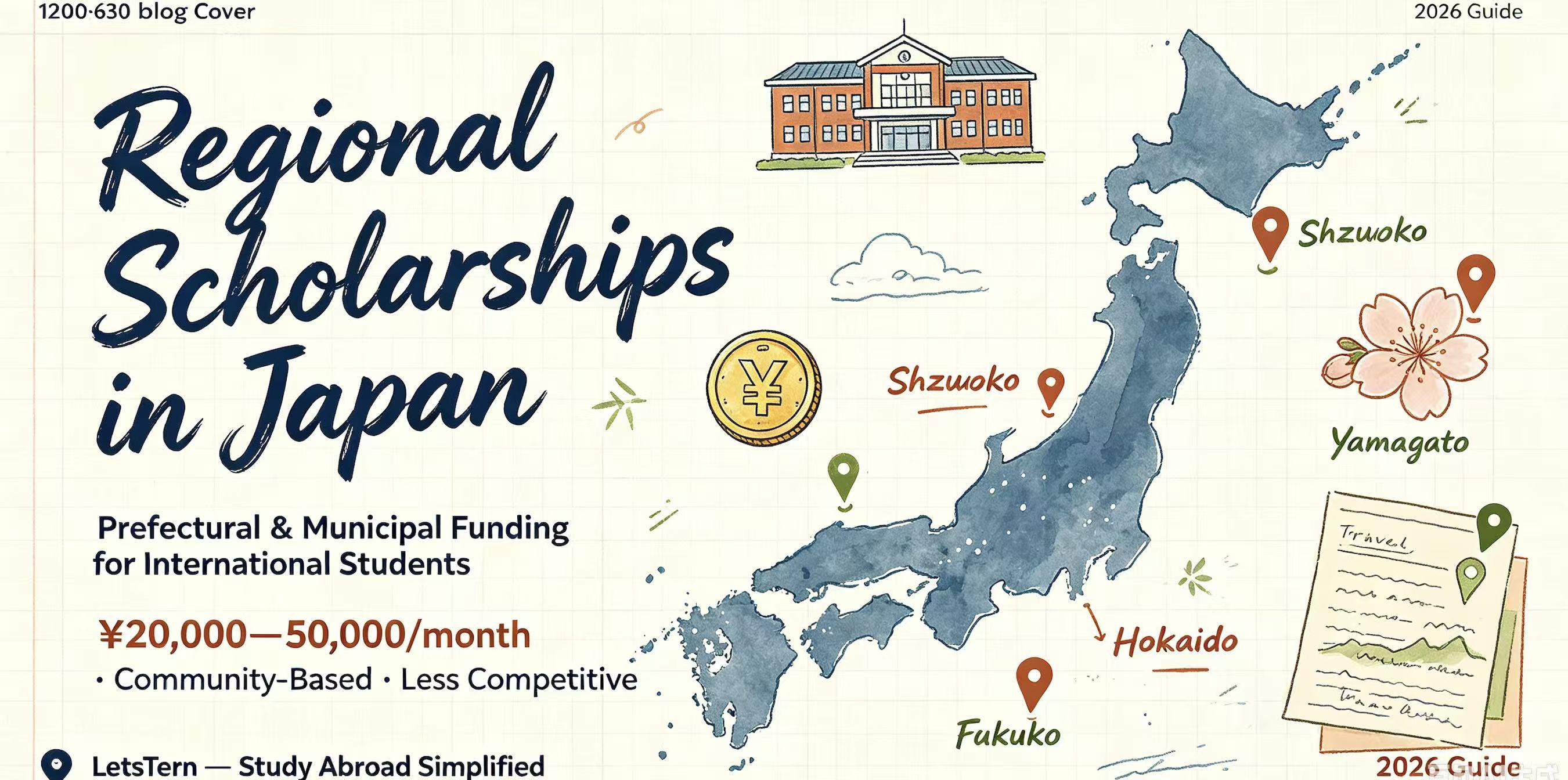
Japan Prefectural Scholarships for International Students 2026
Prefectural and Municipal Scholarships in Japan: A Complete Guide for International StudentsJapan has a reputation for being an expensive place to study. But h…
Read article →
Nitori International Scholarship 2026: Guide for Students
Nitori International Scholarship: A Complete Guide for International Students in JapanJapan has a well-deserved reputation for world-class education. It also h…
Read article →