
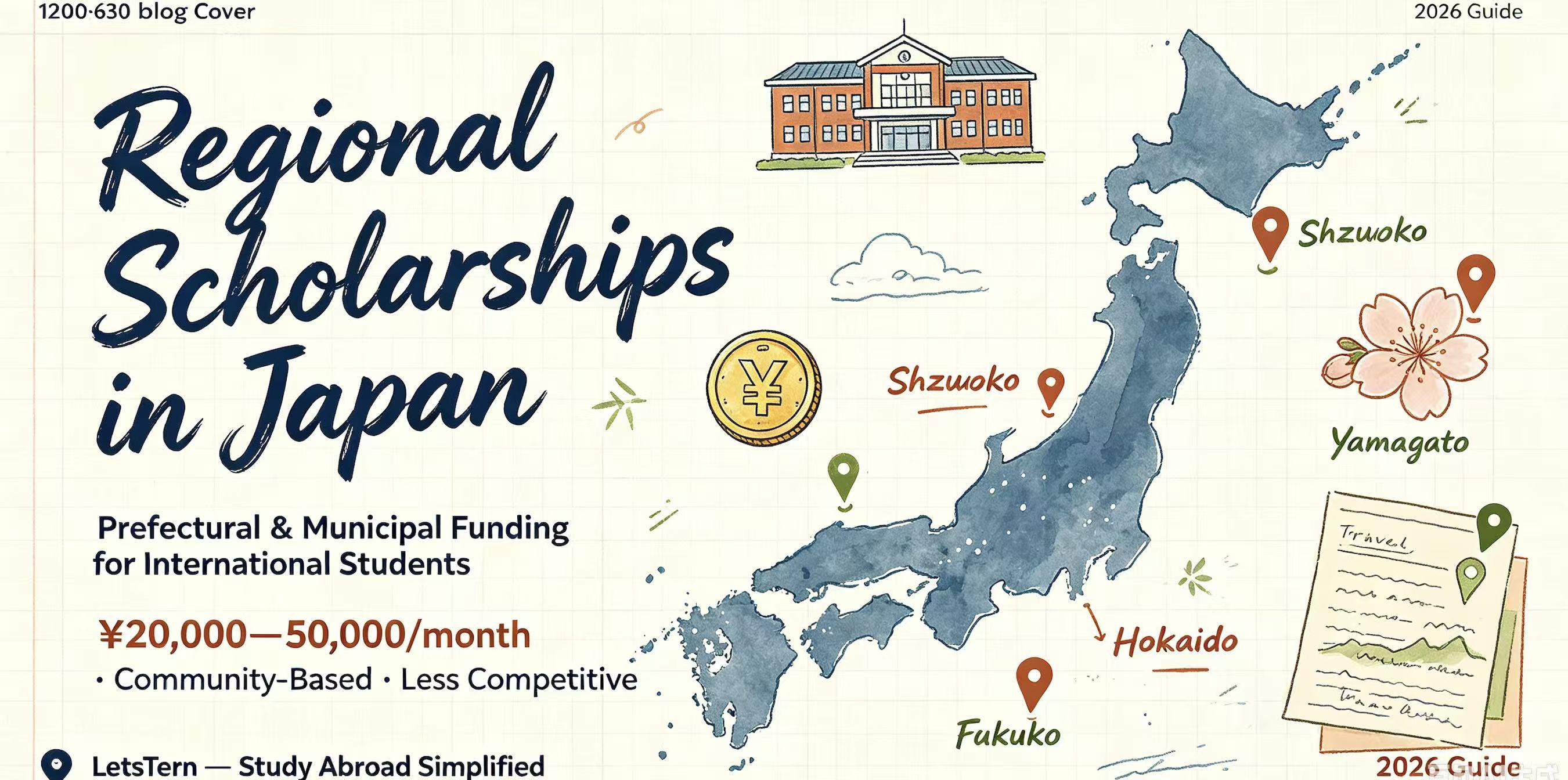
Prefectural and Municipal Scholarships in Japan: A Complete Guide for International Students
Japan has a reputation for being an expensive place to study. But here's something many international students discover too late: hundreds of local government scholarships exist beyond the well-known MEXT and JASSO programs.
These prefectural and municipal scholarships are funded by regional governments and international exchange associations. They're designed to attract and retain international students in specific areas—and many come with far less competition than national scholarships.
The catch? Information is scattered. Each prefecture and city runs its own program with different amounts, deadlines, and eligibility rules. There's no central application portal.
This guide pulls together everything you need to know about local government scholarships in Japan, with real examples from regions like Shizuoka, Yamagata, and Kitami.
What Are Prefectural and Municipal Scholarships?
Japan has 47 prefectures and over 1,700 municipalities. Many of them offer scholarships to international students who live or study in their region.
These scholarships serve a clear purpose: encourage international students to study locally and, in many cases, stay and work in the region after graduation. According to JASSO, there are over 135 local government and private organization scholarships available for students already in Japan, with monthly amounts ranging from ¥20,000 to ¥310,000 [citation:19].
Key difference from national scholarships
MEXT and JASSO are national programs with standardized requirements. Prefectural scholarships are region-specific. You must live in or attend school in the awarding region to qualify. This geographic restriction actually works in your favor—far fewer students compete for these funds.
How Much Do Regional Scholarships Pay?
Amounts vary dramatically. Some municipalities offer modest monthly stipends, while others provide substantial annual grants.
| Region | Scholarship Name | Amount | Type |
|---|---|---|---|
| Yamagata Prefecture | Yamagata Prefectural Scholarship | ¥20,000/month (¥10,000 for Japanese language schools) | Monthly stipend |
| Kitami City (Hokkaido) | Kitami City International Student Support | ¥200,000/year (paid in July and December) | Annual grant |
| Shizuoka Prefecture | Tokai Denpun International Exchange Fund | ¥40,000/month | Monthly stipend |
| Fukuoka City | Fukuoka City International Foundation | ¥600,000/year | Annual grant |
| Tottori Prefecture | Tottori Prefectural Scholarship | ¥20,000/month | Monthly stipend |
The Yamagata scholarship offers ¥20,000 per month for university students and ¥10,000 for Japanese language institute students. The grant period runs for one year (April to March) or six months (October to March) [citation:1][citation:11].
Kitami City's program provides a lump sum of ¥200,000 per year, paid in two installments of ¥100,000 each in July and December. The current quota is 15 students, and last year 36 applicants competed for those spots [citation:4].
Shizuoka spotlight: Tokai Denpun Scholarship
The Tokai Denpun International Exchange Fund is a trust-type scholarship administered through Shizuoka Bank. It provides ¥40,000 per month (¥480,000 annually) to graduate students from Asian countries enrolled at universities in Shizuoka Prefecture. Since its founding in 1998, it has supported 212 students with a total of ¥79.68 million in grants [citation:2].
Who Is Eligible?
Eligibility criteria vary by region, but common requirements include:
- Residence: You must live in the awarding prefecture or city [citation:4][citation:11]
- Enrollment: You must attend a school within that region—university, graduate school, junior college, or specialized training college
- Visa status: You must hold a "Student" (留学) residence status [citation:4][citation:11]
- Financial need: Most scholarships target privately-financed students who need economic assistance [citation:2]
- Academic performance: Requirements range from basic enrollment to specific GPA thresholds
- Concurrent scholarships: Many prohibit receiving other scholarships simultaneously [citation:4][citation:11]
Special Eligibility Conditions
Some regional scholarships have unique requirements worth noting:
- Yamagata Prefecture: Applicants must express a desire to work in Yamagata after graduation [citation:1][citation:11]
- Shizuoka's Tokai Denpun: Restricted to graduate students from Asian countries [citation:2]
- Tottori Prefecture: Limited to students from specific partner regions (South Korea's Gangwon, China's Jilin, Russia's Primorsky Krai, and others) [citation:16]
- Fukuoka City: Applicants must intend to find employment or start a business in Fukuoka [citation:17]
How to Apply
There's no unified application system. Each scholarship has its own process, but most follow a similar pattern:
- Check with your school's international office. Most prefectural scholarships require applications submitted through your university. The school acts as the intermediary [citation:2][citation:4].
- Confirm your eligibility. Read the official guidelines carefully. Some scholarships have age limits, nationality restrictions, or specific field-of-study requirements.
- Prepare required documents. Common requirements include application form, academic transcripts, research summary, recommendation letter, and proof of residence.
- Submit by the deadline. Deadlines vary widely. Yamagata accepts applications in April-May or October-November [citation:1]. Kitami's deadline is in late May [citation:4]. Shizuoka's Tokai Denpun deadline is the end of May [citation:2].
- Wait for selection results. Most scholarships involve document screening. Some also conduct interviews [citation:16].
Application timeline examples
Shizuoka's Tokai Denpun: Applications due late May, selection in July, payments begin July [citation:2]. Kitami City: Applications in late May, results announced thereafter [citation:4]. Tottori Prefecture: Applications due September 25 for October-March coverage [citation:16].
How to Find Scholarships in Your Region
Since there's no central portal, you'll need to do some digging. Here's how:
- Start with your university's international office. They maintain lists of scholarships available to their students and often know about local government programs.
- Search the JASSO Scholarship Pamphlet. JASSO publishes a comprehensive booklet listing all known scholarships, including prefectural and municipal programs. Download it from the JASSO website [citation:6].
- Visit your prefectural or city website. Search for "奨学金" (scholarship) plus the name of your region. Many local governments have dedicated pages for international student support.
- Check international exchange associations. Organizations like the Fukuoka City International Foundation and Tottori International Exchange Foundation administer scholarships on behalf of local governments [citation:16][citation:17].
- Ask your professors. Faculty members often know about regional scholarships, especially those related to their research fields or local industry connections.
Tips for a Strong Application
- Emphasize your connection to the region. Local governments want students who will contribute to their community. If you plan to work there after graduation, say so clearly [citation:17].
- Apply early. Some scholarships have limited quotas. Kitami City accepts 15 students per year [citation:4]. Getting your application in early shows genuine interest.
- Write a compelling research summary. For research-oriented scholarships like Shizuoka's Tokai Denpun, your research overview is a key selection criterion. Structure it clearly with research theme, purpose, methodology, and future plans [citation:2].
- Check concurrent scholarship rules. Many regional scholarships prohibit receiving other funding simultaneously. If you already have JASSO, you may need to choose [citation:4][citation:11].
- Visit the region. If possible, attend local events or join community activities before applying. This demonstrates genuine commitment to the area.
Common Mistakes to Avoid
- Assuming all scholarships are national. Many international students only know about MEXT and JASSO. Regional scholarships are less competitive but require you to live in a specific area.
- Missing school deadlines. Even though the scholarship is from the local government, your school often sets an earlier internal deadline [citation:2][citation:4].
- Ignoring language requirements. Some scholarships require Japanese proficiency (N3 or N2 level) for interviews or documentation [citation:10].
- Not reading the fine print. Some scholarships require you to work in the region after graduation or participate in exchange activities [citation:1][citation:17].
- Giving up if you're not from the "right" country. While some scholarships target specific partner regions, many are open to all nationalities. Check the eligibility criteria carefully [citation:4][citation:11].
Frequently Asked Questions
What is the difference between prefectural and municipal scholarships?
Prefectural scholarships are offered by Japan's 47 prefectures (like Yamagata or Shizuoka). Municipal scholarships are offered by individual cities or towns (like Kitami City in Hokkaido). Both target students living or studying in that specific region.
How much can I receive from a regional scholarship?
Amounts vary widely. Yamagata offers ¥20,000 per month, Kitami City provides ¥200,000 per year, and Fukuoka City offers ¥600,000 annually. Monthly stipends typically range from ¥20,000 to ¥50,000 [citation:1][citation:4][citation:17].
Can I receive a prefectural scholarship and JASSO at the same time?
Often, no. Many regional scholarships prohibit concurrent receipt of other scholarships, including JASSO. Check the specific guidelines for each scholarship before applying [citation:4][citation:11].
How do I find scholarships in my prefecture or city?
Start with your university's international student office—they often maintain lists of available scholarships. You can also search the JASSO Scholarship Pamphlet, which lists over 135 local government and private scholarships available in Japan [citation:19].
Do I need to speak Japanese to apply for regional scholarships?
It depends on the scholarship. Some require Japanese proficiency for interviews or documentation (N3 or N2 level). Others focus primarily on academic merit. Always check the specific requirements [citation:10].
What is the Shizuoka Prefecture Scholarship?
Shizuoka Prefecture has multiple scholarship programs. The most notable is the Tokai Denpun International Exchange Fund, which provides ¥40,000 per month to graduate students from Asian countries enrolled at universities in Shizuoka. There's also the Shizuoka University tuition waiver program for students from specific Asian countries [citation:2][citation:15].
Final Thoughts: Are Regional Scholarships Worth Pursuing?
Absolutely. While MEXT and JASSO get most of the attention, prefectural and municipal scholarships offer a valuable alternative. The amounts are smaller, but the competition is significantly lower—and in some cases, the odds are much better.
The trade-off is geographic. You need to live in or attend school in the awarding region. But for students already studying in areas like Shizuoka, Yamagata, or Fukuoka, these scholarships represent money that's simply waiting to be claimed.
The key is proactive research. No one will hand you a list of regional scholarships. You need to visit your international office, search local government websites, and ask questions. The students who do this often discover funding opportunities their peers never knew existed.
For more scholarship opportunities and guidance on studying in Japan, explore LetsTern's scholarship database and country guides.
Next step
Contact your university's international student office today. Ask specifically about prefectural and municipal scholarships available to students in your region. Also download the JASSO Scholarship Pamphlet for a comprehensive list of local government programs. For official guidelines, visit the Study in Japan scholarship page.
Related articles
More from Scholarships and recent posts.

University-Specific Scholarships in Japan: Todai Fellowship Guide
University-Specific Scholarships in Japan: The Todai Fellowship and BeyondWhen international students think about funding their studies in Japan, MEXT and JASS…
Read article →
Nitori International Scholarship 2026: Guide for Students
Nitori International Scholarship: A Complete Guide for International Students in JapanJapan has a well-deserved reputation for world-class education. It also h…
Read article →
JASSO Scholarship Guide for International Students 2027
JASSO Monbukagakusho Honors Scholarship: Your Complete Guide for International StudentsJapan has a reputation for being expensive. Rent, food, textbooks — it…
Read article →