

Introduction
“Why did I lose marks in IELTS Writing even though my essay felt good?”
If you’ve ever asked yourself this question, you are not alone. Many students preparing for IELTS face the same challenge. Writing is one of the hardest modules because it doesn’t just test grammar it checks your ability to express ideas clearly, organize thoughts logically, and use academic vocabulary naturally.
The truth is: most students don’t fail because they lack knowledge. They fail because they repeat avoidable mistakes. Let’s look at these mistakes in detail and, more importantly, how to avoid them.
Why IELTS Writing Matters for International Students
Studying abroad is a dream for millions of students every year. To get there, IELTS is often the first hurdle. Writing matters because:
- Universities abroad rely on essays and reports. If your writing score is weak, they may question your academic readiness.
- Scholarships often require strong English writing. A higher IELTS score makes your application stand out.
- Everyday student life abroad involves writing. From emails to professors to group assignments, you’ll need clear writing skills.
In other words, IELTS Writing is not just an exam—it’s your practice ground for future academic success in another country.
Mistake #1: Misunderstanding the Task
Many students write excellent English but fail to address the actual question.
Example:
- Task: “Some people believe that studying abroad improves students’ future career opportunities. To what extent do you agree or disagree?”
- Mistake: Writing only about “benefits of studying abroad” without answering the agree/disagree part.
Why it happens: In some cultures, students are used to writing long general answers, but IELTS expects precise, focused responses.
How to Avoid It:
- Underline keywords. (Agree/disagree, advantages/disadvantages, both views, opinion).
- Answer directly. Example: “I strongly agree that studying abroad improves career opportunities because…”
- Check your essay before finishing. Ask yourself: “Did I answer every part of the question?”
- Mistake #2: Weak Essay Structure
Without structure, even good ideas look messy. Examiners need to see a logical flow.
How to Avoid It:
Use the 4-Paragraph Essay Formula (easy to remember, examiner-friendly):
1.Introduction – Paraphrase the question + state your opinion.
Example: “Many people believe studying abroad enhances career growth. I agree because it improves communication skills and global exposure.”
2.Body Paragraph 1 – First main reason + example.
- Example: “Firstly, international students develop stronger communication skills. For instance, adjusting to life in Canada or Australia requires learning formal academic writing, which employer’s value highly.”
3.Body Paragraph 2 – Second main reason + example.
- Example: “Secondly, global exposure allows students to adapt quickly in multinational companies. For example, graduates who studied in the UK often find it easier to work with colleagues from diverse cultures.”
4.Conclusion – Restate your opinion clearly.
- Example: Therefore, studying abroad significantly increases career opportunities by enhancing communication skills and providing global exposure.
- This clear structure makes your essay easier to read—and easier to score high.
Mistake #3: Repetition of Words and Ideas
Students often write: “Studying abroad is good. It is very good. This is a good opportunity for students.”
Problem: Repetition shows limited vocabulary, which directly reduces your band score.
How to Avoid It:
- Use synonyms: good → beneficial, valuable, advantageous and effective.
- Use academic vocabulary: instead of “students learn new things”, write students gain intercultural competence and academic knowledge.
Learn collocations (common word pairs): make progress, gain experience, and build confidence.
Quick Tip: Keep a vocabulary journal. Whenever you learn a new word, write 2–3 sentences with it. This way, you’ll remember to use it naturally in your essays.
Mistake #4: Grammar and Sentence Errors
Even students with strong ideas lose marks because of small grammar issues. Common mistakes include:
- Missing articles (a, an, the).
- Wrong verb tenses (Students was happy → Students were happy).
- Overusing long, complicated sentences that confuse the examiner.
How to Avoid It:
- Write short, clear sentences. Simplicity is powerful.
- Revise common grammar rules (subject-verb agreement, plural forms and prepositions).
- Practice rewriting your sentences in two ways—this builds flexibility.
Example:
Wrong: “Many students wants study abroad because it helps to future.”
Correct: “Many students want to study abroad because it helps their future careers.”
Mistake #5: Lack of Coherence (No Flow)
Your essay may have good points, but if sentences don’t connect, it feels broken.
How to Avoid It:
- Use linking words: firstly, however, therefore, in contrast, as a result.
- Each paragraph should begin with a topic sentence.
- Connect sentences smoothly: Studying abroad builds confidence. In addition, it teaches independence.
Think of your essay as a journey. Linking words are the “road signs” that guide the examiner smoothly.
Mistake #6: Ignoring Time Management
Many students spend too long on Task 1 (the report/letter) and rush through Task 2 (the essay). Since Task 2 carries double the marks, this is a big mistake.
How to Avoid It:
- Spend 20 minutes on Task 1, 40 minutes on Task 2.
- Practice with a timer before exam day.
- Don’t waste 10 minutes thinking plan quickly, then start writing.
Practical Tips for IELTS Writing Success
Practice daily. Write one Task 1 and one Task 2 every other day.
Read international news. Websites like BBC or The Guardian help you learn vocabulary for common topics (education, health, environment, technology).
Get feedback. A mentor, teacher, or Letstern coach can point out mistakes you don’t notice.
Review past mistakes. Keep a list of grammar or vocabulary errors and check it before writing.
Stay calm on exam day. Stress leads to silly mistakes. Breathe, plan, then write.
Conclusion
IELTS Writing is not about perfect English—it’s about clear communication, strong structure, and task completion. By avoiding these mistakes and practicing smarter, you can raise your score and feel more confident about studying abroad.
Remember: IELTS is just one step. The real goal is to prepare you for university assignments, research papers, and professional communication in your future career abroad.
Call to Action
At Letstern, we don’t just prepare students for exams—we prepare them for success abroad. From IELTS coaching and personalized feedback to mock interviews, memberships and a global student community, we help you build the skills you’ll need for university life.
Ready to boost your IELTS writing score and open the door to global opportunities? Join Letstern today and take your first step towards your study abroad dream.
Meta Description
Discover the most common IELTS Writing mistakes and learn practical strategies to avoid them. Boost your band score and prepare for study abroad success.
Suggested Titles
1. Common IELTS Writing Mistakes and How to Avoid Them
2. Top Writing Errors That Lower IELTS Scores (and Fixes)
3. IELTS Writing Success: Avoid These Mistakes for a Higher Band
4. How to Write Better in IELTS: Mistakes Students Must Stop Making
5. Boost Your IELTS Score: Writing Tips Every Student Needs
Key Takeaways (for Social Media)
1. Always answer all parts of the IELTS Writing task.
2. Use a 4-paragraph essay structure for clarity.
3. Expand vocabulary with synonyms and collocations.
4. Focus on grammar accuracy over complexity.
5. Manage time wisely 40 minutes for Task 2, 20 for Task 1.
Related articles
More from Tips - How to do Things? and recent posts.
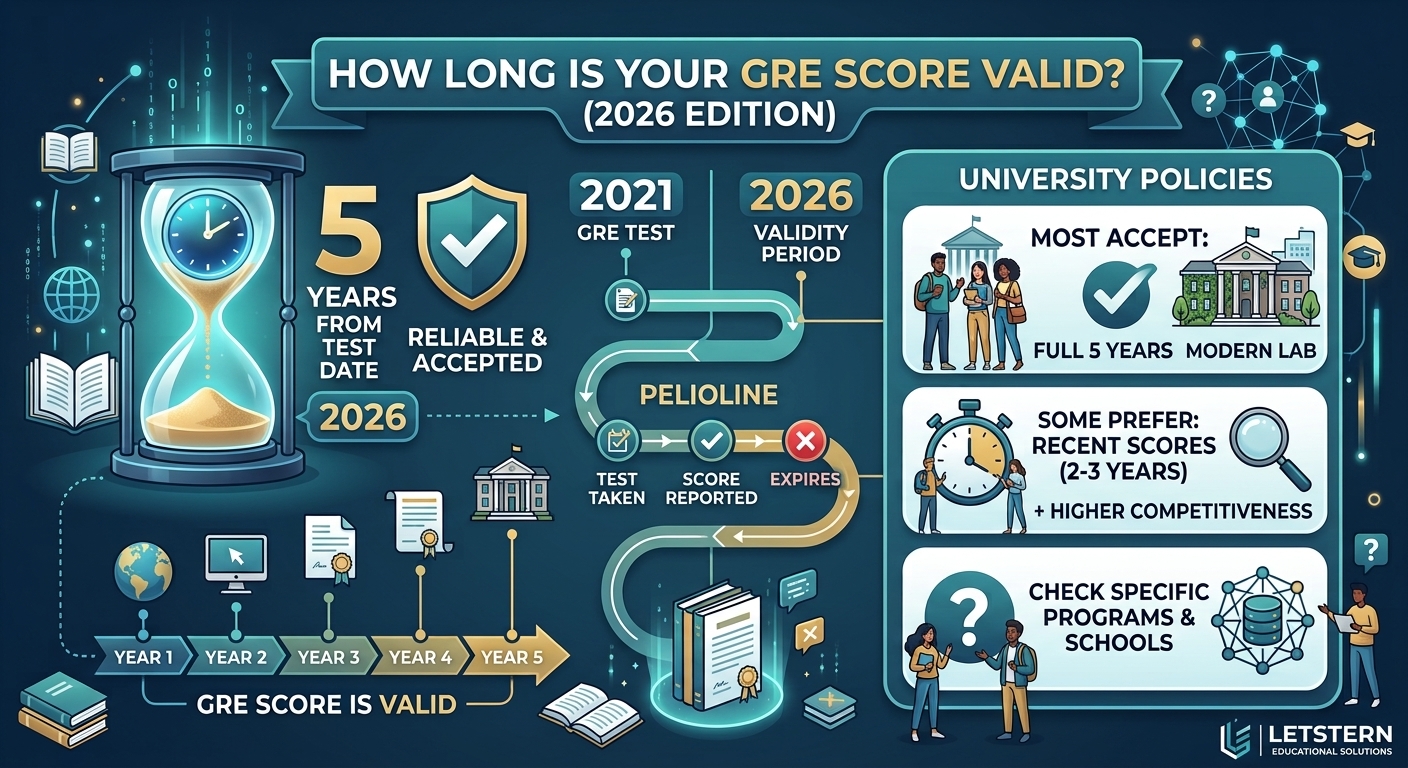
How Long GRE Score Is Valid (2026) | 5-Year Rule & University Policies
If you're planning to apply for graduate school abroad, one of the most important details to track is your GRE score validity. Many students assume their score…
Read article →
Top University Prep Courses in London, Manchester & Birmingham 2026
Dreaming of studying at a UK university but unsure if your qualifications or English skills are ready? University preparation courses—including foundation ye…
Read article →
DAAD Scholarship: Your Gateway to Studying in Germany
DAAD Scholarship: Your Gateway to Studying in GermanyDreaming of studying in Germany, home to some of the world's most prestigious universities and a thriving…
Read article →