
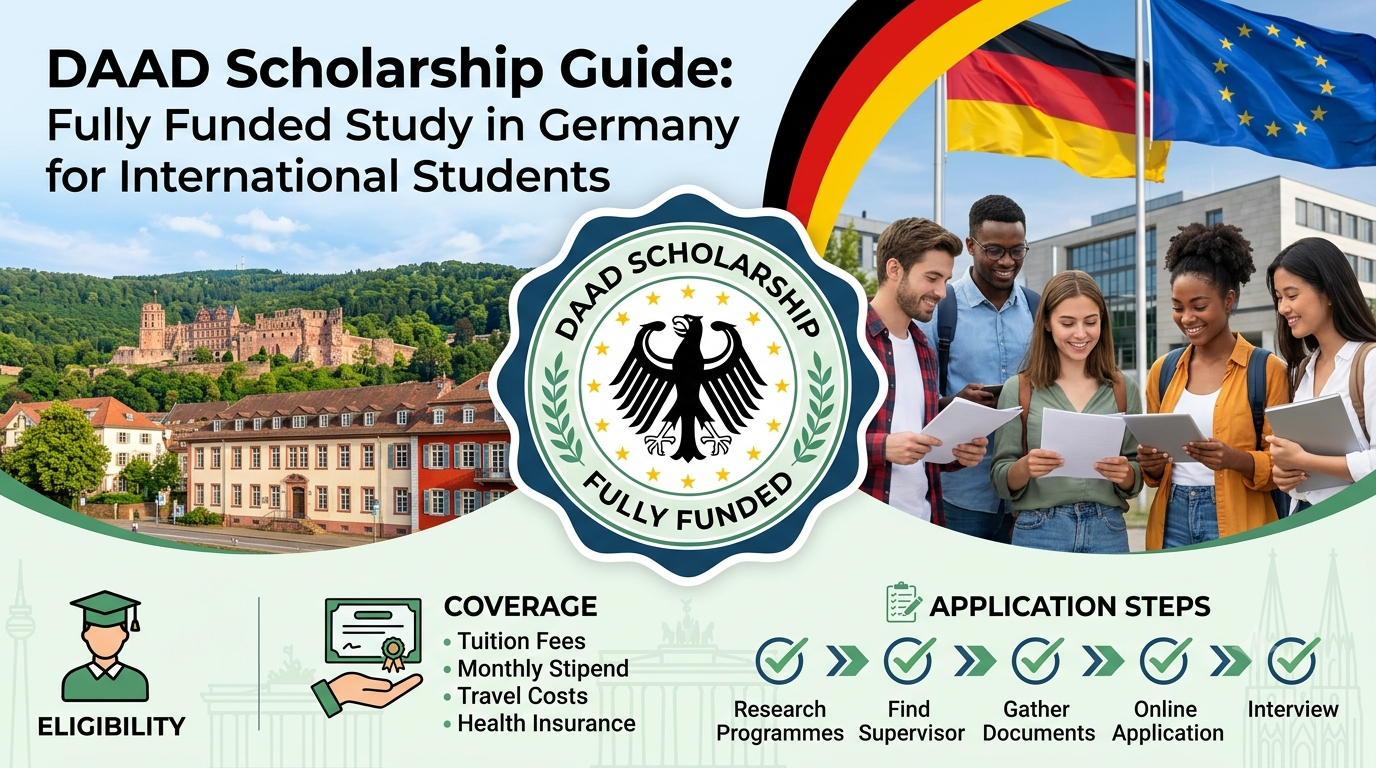
DAAD Scholarship: Your Gateway to Studying in Germany
Dreaming of studying in Germany, home to some of the world's most prestigious universities and a thriving innovation economy? The DAAD scholarship (German Academic Exchange Service) is one of the most prestigious and comprehensive funding opportunities available to international students worldwide [citation:1].
As the world's largest funding organisation for international graduates and doctoral students, DAAD offers fully funded scholarships that cover monthly stipends, health insurance, travel allowances, and more [citation:1][citation:9]. Whether you're pursuing a Master's degree or a PhD, this guide will walk you through everything you need to know about the DAAD scholarship for 2026.
💡 Key Insight
DAAD scholarships are government-funded and do not need to be repaid. They are designed to support outstanding students from around the world, with a particular focus on applicants from developing and emerging countries [citation:9][citation:12].
What Does the DAAD Scholarship Cover?
The DAAD scholarship is among the most comprehensive funding packages available for international students. Here's what you can expect [citation:6][citation:9]:
- Monthly stipend of €992 for Master's students and €1,300 (€1,400 from February 2026) for doctoral candidates [citation:9]
- Health, accident, and personal liability insurance – Comprehensive coverage throughout your stay [citation:2][citation:6].
- Travel allowance – A lump sum to cover your journey to Germany (upon application) [citation:2][citation:6].
- Annual study allowance of €460 – To support your academic materials and expenses [citation:2][citation:6].
- Monthly rent subsidy – Additional support for accommodation costs [citation:6].
- Family allowance – For accompanying spouses (€276/month) and children (€259/month per child) [citation:9].
- German language course – 2-6 months of language training before your studies begin if your program is in German [citation:6].
- Green Mobility Top-Up – Support for climate-friendly travel or reimbursement of carbon offset payments [citation:6].
📌 Important Note
The DAAD scholarship does not cover tuition fees. However, public universities in Germany generally have low or no tuition fees, making this a manageable expense [citation:3][citation:6].
Types of DAAD Scholarships
DAAD offers a wide range of scholarship programmes for different academic levels and disciplines [citation:11][citation:14]:
Master's Scholarships
- Study Scholarships - Master Studies for All Academic Disciplines – For graduates with a first academic degree who want to continue their academic training in Germany [citation:2].
- EPOS (Development-Related Postgraduate Courses) – For students from developing countries in development-focused fields
- STEM Scholarships – For innovation-driving STEM fields to support qualification and employability [citation:14].
- Subject-specific Master's Scholarships – For music, fine art, performing arts, and architecture [citation:3].
Doctoral Scholarships
- Research Grants in Germany – For young scientists and academics pursuing doctoral degrees [citation:4].
- Bi-nationally Supervised Doctoral Degrees (Cotutelle) – For jointly supervised PhD programs between German and home universities
Other Opportunities
- University Summer Courses in Germany – For students wanting to improve German proficiency and cultural knowledge [citation:4].
- Study Visits for Academics - Artists and Architects – For university teachers and artists [citation:14].
Eligibility Criteria
While specific requirements vary by programme, here are the general eligibility criteria for DAAD Master's scholarships [citation:5]
Academic Requirements
- Bachelor's degree – You must hold a first academic degree (typically 3.5 to 4 academic years) in a relevant field [citation:5]
- Above-average grades – Generally, a GPA of 2.5 or lower (German grading system) is required [citation:5].
- Degree age – Your latest academic degree must not be older than 6 years at the time of application [citation:5][citation:8].
Professional Experience
- Minimum 2 years of professional experience – This is required for the EPOS programme and many other DAAD scholarships
- Relevant experience – Work experience must be in a field related to your chosen course of study [citation:5].
- Completed by application deadline – Your work experience must be completed by the application closing date [citation:5].
💼 Professional Experience Details
- Work experience can be from multiple jobs at different companies [citation:5]
- Internships do not count toward the 2-year requirement [citation:5]
- Experience must be completed after your Bachelor's degree [citation:5]
Language Requirements
You must prove proficiency in the language of instruction of your chosen programme [citation:5][citation:8]:
For English-Taught Programmes
- IELTS Band 6.0 (all categories) or equivalent [citation:5]
- TOEFL iBT Score 80 or higher [citation:5][citation:8]
- PTE Academic Test Score 59-75 [citation:5]
- Cambridge Certificate FCE [citation:5]
⚠️ Important
A certificate that English was the language of instruction is NOT sufficient. You must submit an internationally recognized language certificate [citation:5]. The Duolingo English Test is NOT accepted [citation:5].
For German-Taught Programmes
- DSH2 or higher [citation:8]
- TestDaF Level 4 (TDN 4) in all parts [citation:8]
Application Deadlines for 2026
Deadlines vary by programme and university. Here are the key dates for 2026 [citation:4][citation:7]:
| Scholarship Type | Application Deadline | Funding Start |
|---|---|---|
| Master's (All Disciplines) | November 16, 2026 | Winter Semester 2027/2028 |
| Master's (STEM) | September 3, 2026 | Winter Semester 2027 |
| Doctoral Research Grants | July 31, 2026 | February 2027 |
✅ Pro Tip
Many DAAD scholarships have deadlines 6-10 months before the semester starts [citation:1]. Start preparing your application at least 6 months in advance to gather all required documents.
Step-by-Step Application Process
Step 1: Find Your Programme
Use the DAAD Scholarship Database to filter scholarships by your country, subject, and academic level [citation:1]. This will show you which programmes are available and their specific requirements.
Step 2: Check Eligibility
Review the eligibility criteria carefully. Ensure you meet the academic, language, and professional experience requirements
Step 3: Prepare Your Application Documents
Gather the following documents for your DAAD application [citation:2][citation:12]:
- DAAD Application Form – Complete the online form [citation:2]
- CV in Europass format – Maximum 3 pages [citation:2]
- Motivation Letter – 1-3 pages explaining your academic and personal reasons [citation:2][citation:13]
- Academic Recommendation Letter – From a professor, ideally on letterhead with a stamp [citation:2][citation:5]
- Certified Copies of Degrees and Transcripts – Including your Bachelor's certificate [citation:2]
- Language Certificates – IELTS/TOEFL for English or DSH/TestDaF for German [citation:2]
- Certificate of Employment – Proving at least 2 years of relevant work experience [citation:5][citation:8]
- School Leaving Certificate with Grades – Your high school diploma [citation:2]
- Valid ID/Passport Copy [citation:2]
📋 Document Tips
- Upload all documents as ONE PDF file in the online portal [citation:5]
- Do NOT send documents via email – they will not be processed [citation:5]
- A letter without a letterhead and original wet signature will not be considered [citation:5]
Step 4: Submit Your Application
There are two main application routes [citation:1][citation:12]:
- Apply directly to the university – Some programmes require you to apply for admission first [citation:12].
- Submit through the DAAD portal – Once you have university admission or proof of application, submit your DAAD application through the online portal at meindaad [citation:13].
Step 5: Interview and Selection
If shortlisted, you may be invited for a telephone or video interview [citation:5]:
- December-January – Shortlisted applicants are contacted for interviews [citation:5]
- End of February/Early March – All applicants are informed of the results [citation:5]
Common Mistakes to Avoid
- Missing the deadline – Applications received after the closing date are not considered [citation:1].
- Submitting an incomplete application – Ensure all documents are in one PDF and properly formatted [citation:5].
- Forgetting certification – Copies of degrees must be certified [citation:2].
- Not meeting the 2-year work requirement – Internships do not count [citation:5].
- Using an invalid language certificate – Only internationally recognized tests are accepted [citation:5].
- Sending documents by email – Applications sent via email are not processed [citation:5].
Frequently Asked Questions
Can international students apply for the DAAD scholarship?
Yes. DAAD scholarships are open to international students from all countries, with a particular focus on applicants from developing and emerging countries [citation:1][citation:12].
Is there an age limit for DAAD scholarships?
Typically, there is no fixed age limit. However, most programmes stipulate that only a certain amount of time should have elapsed since your last degree was obtained (maximum 6 years) [citation:5][citation:9].
Can I apply if I'm already in Germany?
You may apply if you have been in Germany for a maximum of 15 months by the application deadline, provided the programme allows it [citation:9].
Can I apply with a Bachelor's degree older than 6 years?
No. Your latest academic degree must not be older than 6 years at the time of application [citation:5][citation:8].
Can I apply if I already have a Master's degree?
Yes, but you must explain why you want to pursue a second Master's degree. Your current Master's degree should not be older than 6 years [citation:5].
Does the scholarship cover tuition fees?
No. The DAAD scholarship does not cover tuition fees. However, public universities in Germany have low or no tuition fees
Start Your German Study Journey with LetsTern
Navigating the application process for prestigious scholarships like the DAAD can be complex. LetsTern is an AI-powered platform that simplifies international education discovery and admissions, helping students like you explore opportunities at top universities worldwide.
With LetsTern, you can:
- Discover and compare Universities and programs in Germany
- Access comprehensive Scholarships information
- Understand Study Abroad requirements and processes
- Connect with education consultants who can guide your application
Start planning your Student Visa and Application Process today, and let LetsTern help you turn your dream of studying in Germany into reality.
🚀 Ready to Apply for the DAAD Scholarship?
Don't miss the application deadlines. Start your DAAD application today and take the first step toward one of the world's most prestigious scholarship opportunities.
Frequently Asked Questions About DAAD Scholarships
What is the DAAD scholarship?
The DAAD (German Academic Exchange Service) is the world's largest funding organisation for international graduates and doctoral students. It offers fully funded scholarships for Master's and PhD studies in Germany [citation:1].
How much does the DAAD scholarship pay?
Master's students receive €992 per month. Doctoral candidates receive €1,300 per month (increasing to €1,400 from February 2026) [citation:9][citation:10].
What is the application deadline for DAAD scholarships in 2026?
For Master's studies (All Disciplines), the deadline is November 16, 2026. For STEM Master's, it's September 3, 2026. For doctoral research grants, the deadline is July 31, 2026 [citation:4][citation:7][citation:14].
What documents are required for the DAAD application?
You need a completed DAAD application form, CV in Europass format, motivation letter, recommendation letter, certified degrees and transcripts, language certificates, proof of work experience, school leaving certificate, and a valid ID/passport [citation:2]
Do I need work experience for the DAAD scholarship?
Yes. The EPOS programme and many other DAAD scholarships require a minimum of 2 years of professional experience completed after your Bachelor's degree [citation:5][citation:8].
Does the DAAD scholarship cover tuition fees?
No. The DAAD does not cover tuition fees. However, public universities in Germany generally have low or no tuition fees [citation:3][citation:6].
Can I apply if my Bachelor's degree is older than 6 years?
No. Your latest academic degree must not be older than 6 years at the time of application [citation:5][citation:8].
Can I apply if I'm already in Germany?
You may apply if you have been in Germany for a maximum of 15 months by the application deadline, provided the programme allows it [citation:9].
Can I apply with a Duolingo English Test?
No. The Duolingo English Test is not accepted. You need an internationally recognized certificate like IELTS, TOEFL, or Cambridge
What is the Europass CV format?
The Europass CV is a standardized format for European CVs. It is available for free on the Europass website and is required for all DAAD applications [citation:2][citation:13].
Start Your German Study Journey Today
The DAAD scholarship is your opportunity to study at some of the world's finest universities with comprehensive financial support. Don't miss the application deadlines.
Explore German Universities → View Scholarships →
Discover more Study Abroad guides and Country Guides for Germany
Related articles
More from Tips - How to do Things? and recent posts.
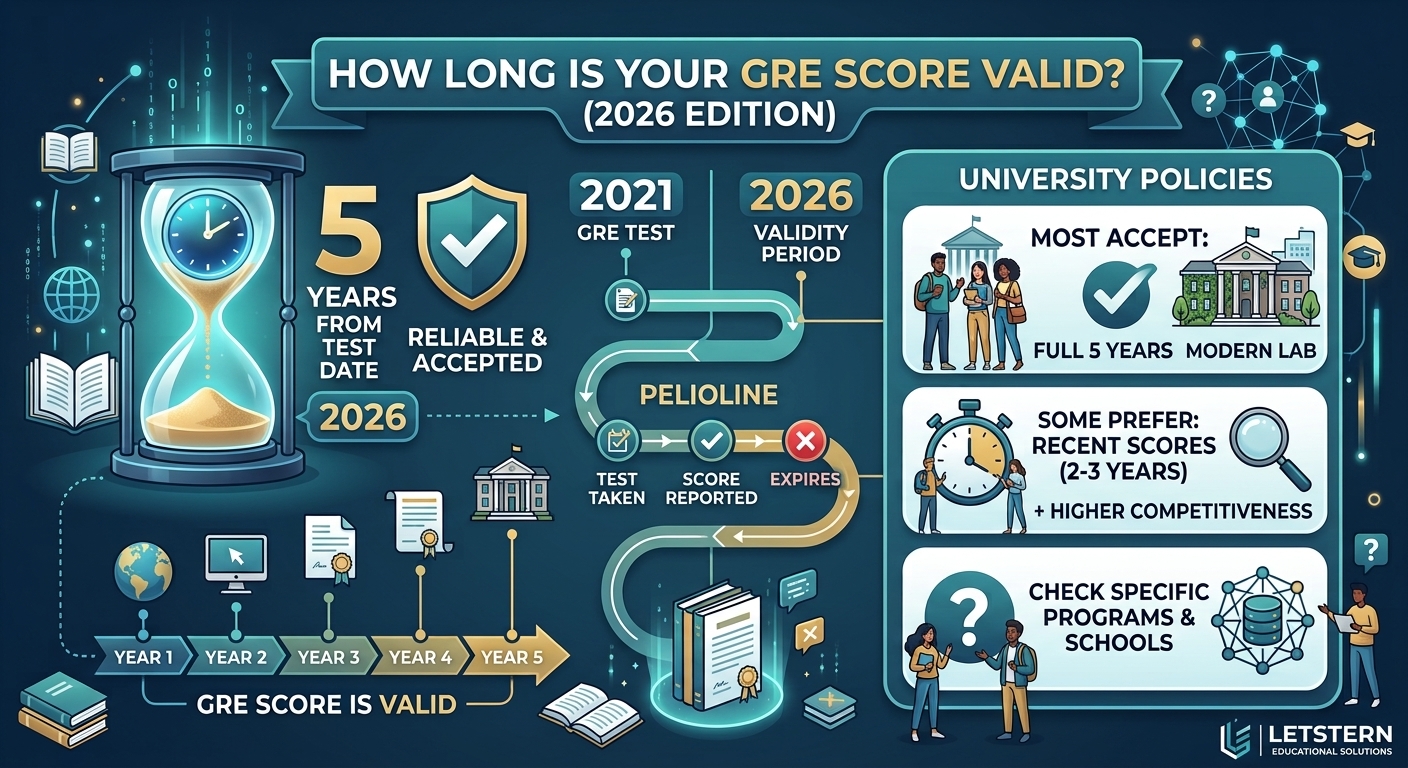
How Long GRE Score Is Valid (2026) | 5-Year Rule & University Policies
If you're planning to apply for graduate school abroad, one of the most important details to track is your GRE score validity. Many students assume their score…
Read article →
Top University Prep Courses in London, Manchester & Birmingham 2026
Dreaming of studying at a UK university but unsure if your qualifications or English skills are ready? University preparation courses—including foundation ye…
Read article →
UNIL Master's Grants: Your Pathway to Studying in Switzerland
Imagine pursuing your Master's degree at one of Switzerland's most prestigious universities, surrounded by the stunning Alps and Lake Geneva, with generous fin…
Read article →