
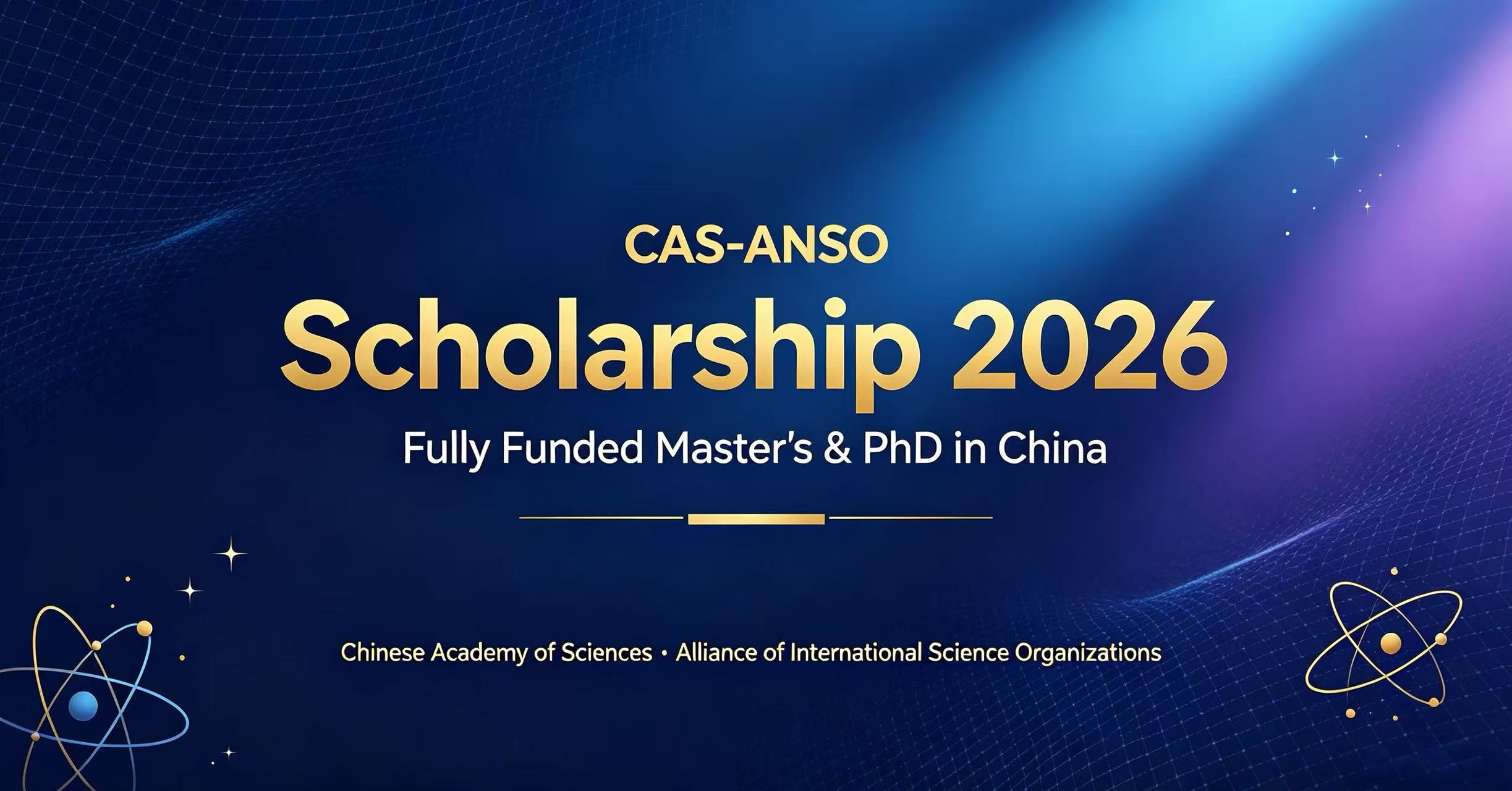
CAS-ANSO Scholarship 2026: Complete Guide to Apply & Win
If you're an aspiring scientist looking for a fully funded opportunity to pursue graduate studies in China, the CAS-ANSO Scholarship deserves your full attention. Backed by the Chinese Academy of Sciences (CAS) — one of the world's leading research institutions — this scholarship opens doors to world-class laboratories, top-tier supervisors, and a vibrant scientific community.
Every year, the CAS-ANSO Scholarship supports 100 to 200 Master's students and 300 PhD students from around the globe. It's not just about funding — it's about launching your scientific career with one of the most prestigious research networks in the world.
This guide covers everything you need to know: eligibility, benefits, application steps, deadlines, and insider tips to make your application stand out. Let's dive in.
Quick Overview: CAS-ANSO Scholarship 2026
- Provider: Chinese Academy of Sciences (CAS) & Alliance of International Science Organizations (ANSO)
- Degree Levels: Master's (up to 36 months) & PhD (up to 48 months)
- Host Institutions: University of Science and Technology of China (USTC), University of Chinese Academy of Sciences (UCAS), and CAS institutes across China
- Coverage: Full tuition waiver, monthly stipend (¥3,000–¥7,000), health insurance, travel allowance, visa fee reimbursement
- Application Period: October 15, 2025 – January 31, 2026 (Beijing Time)
- Official Website: www.anso.org.cn
What Is the CAS-ANSO Scholarship?
The CAS-ANSO Scholarship is a fully funded graduate scholarship program jointly supported by the Chinese Academy of Sciences (CAS) and the Alliance of International Science Organizations (ANSO). It was formally launched in 2019 under the name "ANSO Scholarship for Young Talents" and has since become one of the most prestigious scholarships for international students pursuing science and technology degrees in China.
ANSO itself is a non-profit, non-governmental international organization founded in 2018. Founding members include CAS and 36 other scientific institutions, universities, and international organizations worldwide. The alliance aims to improve regional and global capacity in science and technology, promote sustainable development, and foster broader scientific cooperation.
The scholarship has two main categories: Degree Programs (Master's and PhD) and Non-Degree Programs (short-term academic exchanges and summer schools). This guide focuses on the Degree Program, which offers the most comprehensive funding package.
Types of CAS-ANSO Scholarship Programs
The CAS-ANSO Scholarship offers multiple pathways depending on your academic level and background. Understanding these options is crucial for choosing the right application route.
1. CAS-ANSO Degree Program (Master's & PhD)
This is the flagship program. It supports international students to pursue full Master's or PhD degrees at USTC, UCAS, or any CAS institute across China. The program welcomes applicants from all countries and disciplines within the natural sciences, engineering, and related fields.
2. ANSO-CAS-TWAS/UNESCO PhD Scholarship
Launched in 2022, this is a special sub-category of the CAS-ANSO Scholarship (Degree Program). It is co-funded by CAS, the World Academy of Sciences (TWAS), and UNESCO. Each year, TWAS/UNESCO will select up to 40 PhD students from developing countries for this scholarship category, with 10 scholarships prioritized for recipients engaged in climate-related research. Aligning with TWAS/UNESCO's priority areas, special consideration will be extended to two target groups: Least Developed Countries (LDCs) and women.
3. Non-Degree Program
Starting from 2024, a non-degree program has been launched under the CAS-ANSO Scholarship framework. This supports non-Chinese students to undertake short-term academic visits to USTC, UCAS, and CAS institutes. In 2024, two summer school programs were offered — keep an eye on the official websites for future opportunities.
What Does the CAS-ANSO Scholarship Cover?
This is a comprehensive, fully funded scholarship that covers almost every expense associated with studying in China. Here's the complete breakdown:
CAS-ANSO Scholarship Benefits
| Benefit | Master's Program | PhD Program |
|---|---|---|
| Tuition Waiver | Full | Full (¥40,000/year) |
| Monthly Stipend | ¥3,000/month | ¥6,000 or ¥7,000/month* |
| Duration | Up to 36 months | Up to 48 months |
| Health Insurance | ✓ Covered | ✓ Covered |
| Application Fee | Waived | Waived |
| International Travel | One round-trip allowance | One round-trip allowance |
| Visa/Residence Permit | One-time allowance | One-time allowance |
*PhD stipend is ¥6,000 or ¥7,000/month depending on whether the awardee has passed the qualification test arranged by the University.
💡 Pro Tip from LetsTern
The monthly stipend for PhD students can increase from ¥6,000 to ¥7,000 if you pass the university's qualification test. This is a strong incentive to perform well academically from the start. Plan your studies strategically to qualify for the higher stipend rate.
Important Note for ANSO-CAS-TWAS/UNESCO PhD Scholars
If you're selected under the ANSO-CAS-TWAS/UNESCO sub-category, the funding comes from different sources: CAS covers tuition, stipend, insurance, and application fees, while TWAS/UNESCO covers international travel and visa allowances based on their financial arrangements.
Any scholarship awardee already in China at the time of application will NOT be eligible for any travel subsidy.
Eligibility Requirements for CAS-ANSO Scholarship 2026
Before you invest time in the application, make sure you meet all the eligibility criteria. The requirements are specific and strictly enforced.
Basic Requirements
- Nationality: You must not hold Chinese citizenship.
- Language Proficiency: You must be proficient in English or Chinese.
- No Other Employment: You cannot take up other assignments during the scholarship period.
- No Dual Applications: You may only apply through either USTC or UCAS, not both. Dual applications result in automatic disqualification.
Age Requirements
- Master's applicants: Born on or after January 1, 1996 (inclusive).
- PhD applicants: Born on or after January 1, 1991 (inclusive).
Academic & Admission Requirements
- You must meet the admission criteria for international students of USTC or UCAS.
- Master's applicants: Must hold a Bachelor's degree or equivalent.
- PhD applicants: Must hold a Master's degree or equivalent.
Important Restrictions
⚠️ Critical: You Cannot Apply If...
- You are currently pursuing a master's degree at any university in China and applying for the master's program.
- You are currently pursuing a doctoral degree at any university in China and applying for the PhD program.
- Violation of this rule results in disqualification and notification to your current institution.
CAS-ANSO Scholarship Application Process (Step-by-Step)
The application process is straightforward but requires careful attention to detail. Here's your step-by-step roadmap:
Step 1: Choose Your Host Institution
Decide whether you want to apply through USTC or UCAS. Remember: you can only choose one. Research both institutions thoroughly — look at their research strengths, faculty, and available programs in your field.
Step 2: Review the Official Call for Applications
Read the full 2026 Call for Applications carefully on the ANSO official website. Pay close attention to program-specific requirements and deadlines.
Step 3: Prepare Your Application Materials
Gather all required documents (see checklist below). Make sure every document is in English or Chinese — translations must be notarized if they're in other languages.
Step 4: Complete the Online Application
For UCAS applicants: Log in to the UCAS International Student Admission System at is.ucas.ac.cn, fill in your personal information, upload required documents, and select the CAS-ANSO Scholarship option.
For USTC applicants: Log in to the USTC admission system at isa.ustc.edu.cn and follow the Application Guideline for Graduate Applicants.
Step 5: Submit Before the Deadline
The application window for the 2026 academic year is October 15, 2025 to January 31, 2026 (Beijing Time). Exact dates may vary slightly between USTC and UCAS, so check both websites.
Step 6: Wait for Results
After submission, your application goes through university-level review and then final approval by ANSO and CAS. Results for the 2026 cycle have been announced — UCAS and USTC notify applicants through their application systems or via email.
⏰ Deadline Alert
The CAS-ANSO Scholarship 2026 application deadline is January 31, 2026 (Beijing Time). This is a hard deadline — late applications are not accepted. Start preparing your materials at least 2-3 months in advance.
Required Documents for CAS-ANSO Scholarship Application
Missing or incorrect documents are one of the most common reasons for rejection. Here's the complete checklist:
📋 Complete Document Checklist
- CAS-ANSO Scholarship Application Form (filled and generated from the online system)
- Passport Copy: Scanned copy of the information page (must be valid beyond the program end date)
- Notarized Highest Degree Certificate: Bachelor's for Master's applicants; Master's for PhD applicants
- Official Academic Transcripts: From all post-secondary programs, with official stamps and grading system explanation
- Language Proficiency Certificate: IELTS, TOEFL, or HSK (depending on program language)
- Research Proposal: Detailed proposal outlining your research interests and plans
- Curriculum Vitae (CV): With brief introduction of research experience
- Two Recommendation Letters: From professors or associate professors who know your academic work
- Foreigner Physical Examination Form (valid within 6 months)
- Non-Criminal Record Certificate (issued within 6 months)
Top Tips to Strengthen Your CAS-ANSO Scholarship Application
Competition for the CAS-ANSO Scholarship is intense. Here's how to make your application stand out:
1. Contact Potential Supervisors Early
This is arguably the most important step. Reach out to professors at USTC or UCAS whose research aligns with your interests. A professor's willingness to supervise you can significantly boost your chances.
2. Write a Compelling Research Proposal
Your research proposal should demonstrate originality, feasibility, and alignment with the priorities of CAS and ANSO. If you're applying for the climate-focused or LDC-priority tracks under the ANSO-CAS-TWAS/UNESCO sub-category, emphasize that connection.
3. Highlight Your Fit with ANSO's Mission
ANSO focuses on sustainable development, scientific cooperation, and capacity building in developing regions. If your research addresses these themes, emphasize that connection in your application.
4. Get Strong Recommendation Letters
Choose recommenders who can speak specifically about your research potential and academic achievements. Generic letters won't impress the selection committee.
5. Apply Early
The application window opens in October — don't wait until January. Early applicants often have an advantage as universities review applications on a rolling basis.
📌 Quick Reference: Key Dates for CAS-ANSO Scholarship 2026
- Application Opens: October 15, 2025
- Application Deadline: January 31, 2026 (Beijing Time)
- Results Announced: June 2026
- Program Start: September 2026 (autumn semester)
Common Mistakes to Avoid
Here are the most frequent errors that sink CAS-ANSO applications — and how to avoid them:
Mistake 1: Applying to Both USTC and UCAS
This results in automatic disqualification. Choose one institution and commit to it.
Mistake 2: Missing the Age Cutoff
The age requirements are strict: Master's applicants must be born after January 1, 1996, and PhD applicants after January 1, 1991. If you're even one day over, your application won't be considered.
Mistake 3: Submitting Incomplete or Untranslated Documents
All documents must be in English or Chinese. If they're in other languages, you need notarized translations. Missing stamps, signatures, or translations will get your application rejected.
Mistake 4: Applying While Already Enrolled in a Chinese Degree Program
If you're currently pursuing a Master's in China, you cannot apply for the Master's program. Similarly, current PhD students in China cannot apply for the PhD program. This rule is strictly enforced.
Mistake 5: Not Researching Supervisors Before Applying
Many applicants submit generic applications without contacting any professors. A supervisor's willingness to work with you can make the difference between acceptance and rejection.
Frequently Asked Questions
How many CAS-ANSO Scholarships are awarded each year?
The degree program supports 100 to 200 Master's students and 300 PhD students every year. An additional up to 40 PhD students are selected through the ANSO-CAS-TWAS/UNESCO sub-category.
Is the CAS-ANSO Scholarship renewable?
The scholarship is awarded for the full duration of your program (up to 36 months for Master's, up to 48 months for PhD). However, annual assessments are conducted. Any awardee who fails annual assessments will face consequences including termination of scholarship, discontinuity of study, and receiving only a certificate of attendance rather than a formal degree.
Do I need to know Chinese to apply?
Not necessarily. You must be proficient in English or Chinese. Many programs at USTC and UCAS are taught in English. However, all awardees are required to complete centralized training in Chinese language and culture as part of their program.
Can I work while on the CAS-ANSO Scholarship?
No. Eligible applicants cannot take up other assignments during the scholarship period. The stipend is designed to cover your living expenses so you can focus entirely on your studies and research.
What happens if I don't complete my degree on time?
If you fail annual assessments or cannot complete your degree within the scholarship period, you may face: termination of scholarship, discontinuation of study, and receiving only a certificate of attendance rather than a formal degree.
Can I apply for the CAS-ANSO Scholarship if I'm already in China?
Yes, but with restrictions. If you're already in China on a student visa, you can still apply. However, you will not be eligible for the international travel subsidy. Also, if you're currently enrolled in a Master's or PhD program in China, you cannot apply for the same degree level.
Conclusion
The CAS-ANSO Scholarship is one of the most prestigious and generous funding opportunities for international students pursuing graduate studies in science and technology in China. With full tuition coverage, a competitive monthly stipend, health insurance, and travel allowances, it removes financial barriers and lets you focus on what truly matters — your research and academic growth.
The application window for 2026 opened on October 15, 2025 and closes on January 31, 2026. Start preparing your materials now. Contact potential supervisors. Refine your research proposal. And don't wait until the last minute.
Your journey to becoming a CAS-ANSO scholar starts with a single step — a well-prepared, compelling application. Good luck!
Related articles
More from Scholarships and recent posts.
University-Specific Scholarships in Japan: Todai Fellowship Guide
University-Specific Scholarships in Japan: The Todai Fellowship and BeyondWhen international students think about funding their studies in Japan, MEXT and JASS…
Read article →
Japan Prefectural Scholarships for International Students 2026
Prefectural and Municipal Scholarships in Japan: A Complete Guide for International StudentsJapan has a reputation for being an expensive place to study. But h…
Read article →
Nitori International Scholarship 2026: Guide for Students
Nitori International Scholarship: A Complete Guide for International Students in JapanJapan has a well-deserved reputation for world-class education. It also h…
Read article →